


Facing an insurance company after an accident can feel like an unfair fight. Your car, even after perfect repairs, is now worth thousands less, and you’re the one left with the financial loss. This is where a diminished value lawyer can step in—they are a legal expert specializing in recovering that lost value from the at-fault party’s insurer. Lean more about others experience in hiring diminished value lawyer in reddit.
Think of them as your professional advocate, dedicated to ensuring you receive the full compensation you are rightfully owed.
When to Consider a Diminished Value Lawyer
After a car accident, a common question is, “Do I need a lawyer?” While a diminished value lawyer can be a powerful ally, they aren’t always the first step. The path to fair compensation usually begins with solid evidence, not an immediate lawsuit.
Think of it as a negotiation where you need leverage. The insurance company’s goal is to pay as little as possible. Your goal is to recover your vehicle’s full financial loss. To succeed, you need proof, and a professional appraisal report is the strongest evidence you can have.
The Power of a Certified Appraisal
Before considering legal action, you must prove your loss. A certified appraisal report from a trusted provider like SnapClaim is the foundation of any successful diminished value claim. It provides objective, data-driven evidence of exactly how much value your car has lost.
This isn’t just an opinion; it’s a detailed analysis backed by real market data, your vehicle’s history, and the quality of its repairs. For most vehicle owners, presenting a comprehensive appraisal is enough to make the insurer take the claim seriously and offer a fair settlement. It turns your request into a documented financial demand they can’t easily dismiss.
When a Lawyer Becomes Essential
So, when is it time to bring in legal help? You should start thinking about a diminished value lawyer the moment the insurance company refuses to negotiate fairly.
Look for these red flags:
- Outright Denial: The insurer denies your claim without a valid, lawful reason.
- Stonewalling: They ignore your calls, emails, and the evidence you’ve submitted.
- Unreasonable Offers: The adjuster makes a very low offer and won’t explain how they calculated it.
- Complex Cases: Your claim involves a high-value, exotic, or classic car, or it is connected to a personal injury lawsuit.
In these situations, a lawyer can escalate the matter. They can send a formal letter of representation, threaten legal action, and file a lawsuit if necessary. Their involvement shows the insurer you are serious. The certified appraisal you already have becomes the core evidence that strengthens their legal arguments.
Key Takeaway: Always start with a certified appraisal. It provides the proof you need to negotiate from a position of strength. If the insurer still won’t offer a fair settlement, a diminished value lawyer can use that same report to build a powerful case.
Deciding whether to start with an appraisal or go straight to a lawyer can be tricky. This table breaks down common scenarios to help you choose the right path.
Appraisal First vs. Lawyer: When to Choose Each Path
| Your Situation | Best First Step: Certified Appraisal | When to Escalate to a Lawyer |
|---|---|---|
| Standard Accident | Your claim is straightforward with clear fault. An appraisal provides the evidence needed to negotiate directly. | The insurer denies your claim, makes a lowball offer, or refuses to respond to your appraisal. |
| High-Value Vehicle | An appraisal is critical to establish the significant loss in value on an exotic, luxury, or classic car before contacting the insurer. | The claim is complex, involves multiple parties, or the insurer is known for being difficult with high-value claims. |
| Minor to Moderate Damage | A certified appraisal is a cost-effective way to document your loss and is often enough to secure a fair settlement without legal fees. | The insurer is delaying the process, or the settlement offer doesn’t even cover the cost of the appraisal. |
| Clear Evidence | You have all repair invoices and documentation. An appraisal organizes this information into a professional demand package. | Even with overwhelming proof, the adjuster is stonewalling you or disputing valid evidence. |
Ultimately, the goal is to resolve your claim efficiently. Starting with a certified appraisal resolves most cases without the time and expense of hiring an attorney, but knowing when to escalate is key to getting the compensation you deserve.
Understanding What Diminished Value Really Means
To understand why you might need a diminished value lawyer, you must first grasp what “diminished value” is. It’s a simple concept that insurance companies often make complicated.
Simply put, diminished value is the loss in your car’s resale value after an accident, even if it was repaired perfectly.
Many drivers assume that once a top-rated body shop fixes their car, it’s restored to its pre-accident value. However, the market sees it differently. A vehicle with an accident on its record is less desirable to a potential buyer than the same car with a clean history. That difference in value is a real financial loss you are entitled to recover.
The Three Types of Diminished Value
Diminished value isn’t just one number; it can be broken down into three types. Understanding the difference helps clarify what you can claim. One of these types is the basis for nearly every successful diminished value claim.
Even the National Association of Insurance Commissioners (NAIC) recognizes these categories. This is important because insurance adjusters often try to value your loss based on a few photos, which almost always results in a low offer. You can review insurance industry findings on their official site.
Here’s a simple breakdown:
Immediate Diminished Value: This is the drop in your car’s value right after the accident, before any repairs begin. It’s a temporary figure.
Repair-Related Diminished Value: This is a loss caused by poor-quality repairs. If the body shop uses aftermarket parts, fails to match the paint, or leaves lingering mechanical issues, the car’s value is further reduced.
Inherent Diminished Value: This is the most important one. It’s the permanent, unavoidable loss in value that occurs simply because the vehicle now has an accident history. Even with flawless repairs, the vehicle is permanently branded.
Why Inherent Diminished Value Is What Matters
For almost every claim, inherent diminished value is the key focus. This is the financial damage that will affect your car for the rest of its life. A CARFAX or AutoCheck report will show the collision forever, causing future buyers to either walk away or demand a lower price.
This is where the dispute with the insurance company begins. They will argue their responsibility ends after paying the repair bill. However, the law in most states requires them to “make you whole,” which includes compensating you for this proven loss in market value.
The Core of Your Claim: The at-fault driver’s insurance company is responsible for more than just fixing your car. They must also compensate you for the loss in its resale price caused by the accident history.
Without proof, your claim is just your opinion against theirs. This is why a certified appraisal report is essential. It provides the hard, market-based data to prove your financial loss, turning a potential argument into a factual negotiation. A strong report is the exact evidence a diminished value lawyer needs to build a winning case.
Navigating the Diminished Value Claim Process
Filing a diminished value claim can feel complex, but it becomes much clearer once you understand the steps. The process is not about starting a fight; it’s about being prepared for a business negotiation.
It all starts with building a solid case. The first step is to send a formal demand package to the at-fault driver’s insurance company. This is a professional presentation outlining your financial loss.
The core of this package is a certified, data-driven appraisal report. This document elevates your claim from an opinion to a factual demand for fair compensation. It gives the adjuster the market analysis they need to justify the payout you are requesting.
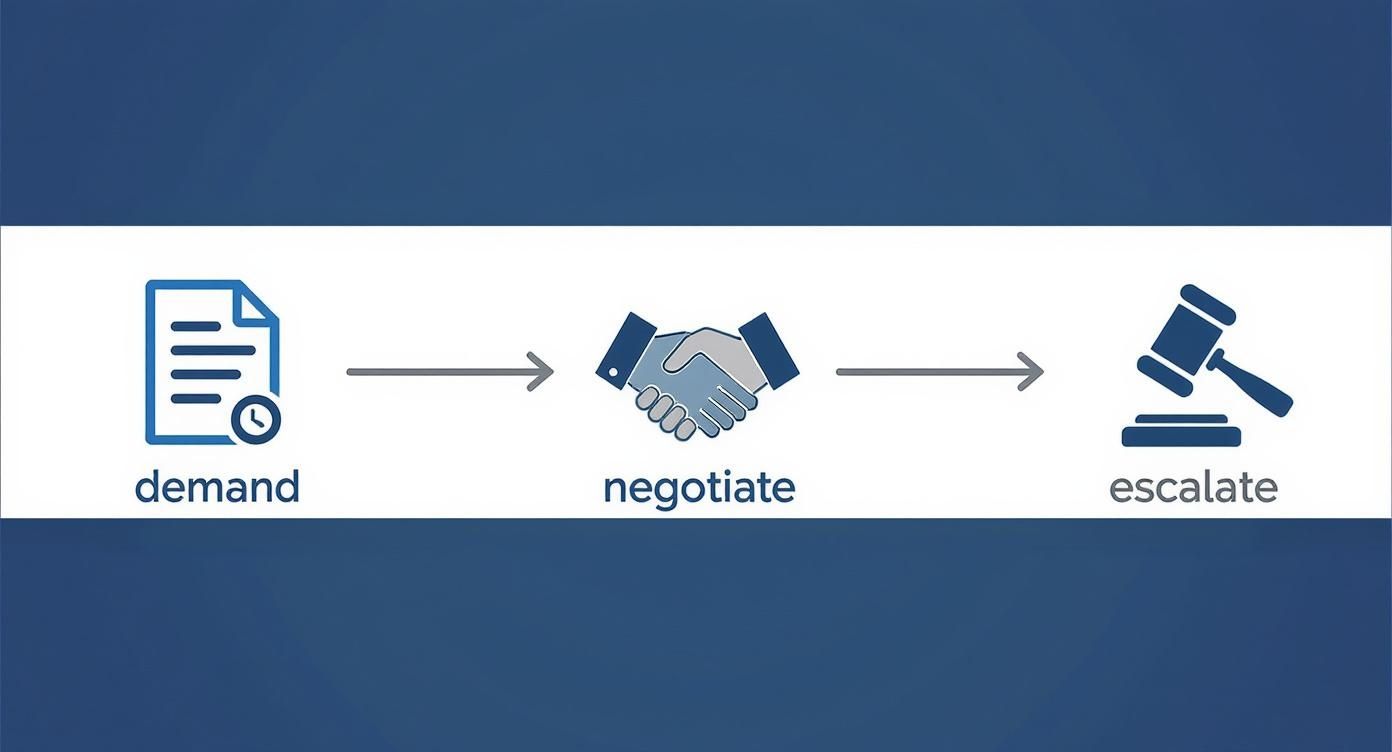
The Negotiation Phase
Once your demand package is submitted, the negotiation begins. You’ll be dealing with a professional whose job is to minimize claim payouts for their company. They use specific tactics to achieve this.
Be ready for these common strategies:
- The Flawed Formula: Many insurers use a generic internal formula (like the “17c” formula) that almost always produces a very low offer.
- Questioning Your Proof: They may try to discredit your appraisal without offering any real market data to support their lower number.
- The Waiting Game: Some adjusters delay the process, hoping you’ll get frustrated and accept a poor offer just to be done with it.
Your best defense is to remain calm, professional, and stick to the facts in your appraisal. A high-quality report from SnapClaim gives you the objective data needed to counter their arguments and keep the focus on your actual financial loss. We explain this process in our detailed guide on how to claim diminished value.
When to Bring in a Lawyer
What happens if you’ve sent undeniable proof and the insurance company still won’t offer a fair settlement? This is when you should hire a diminished value lawyer.
Having a lawyer on your side signals to the insurer that you’re serious. The claim typically escalates in a few stages:
- Letter of Representation: Your attorney sends a formal letter notifying the insurance company that they now represent you. This often makes the insurer take the claim more seriously.
- Legal Pressure: The lawyer restarts negotiations, but this time with the clear threat of a lawsuit. They will use your appraisal report as the cornerstone of their legal argument.
- Filing a Lawsuit: If the insurer continues to act in bad faith, filing a lawsuit is the final step. Fortunately, a strong, court-ready appraisal often convinces them to settle long before this becomes necessary.
A strong appraisal builds a case so compelling that the insurer often realizes settling is a much smarter option than risking a loss in court. This can save you time, stress, and legal fees.
The personal injury law sector, which handles diminished value claims, was valued at $53.1 billion in 2022, showing that more car owners are turning to experts to recover what they’re owed.
Clear Signs It’s Time to Hire an Attorney
Knowing when to stop negotiating and contact a lawyer can be challenging. While a solid appraisal report often resolves a diminished value claim, there are times when the insurance company’s actions make legal help necessary.
Recognizing these red flags is key to protecting your claim. If you feel stuck in a cycle of delays and denials, it’s probably time to bring in a professional. A diminished value lawyer can break the stalemate and signal to the insurer that you’re serious about recovering your car value after accident losses.
The Insurance Company Denies Your Claim
An outright denial is the clearest sign you need legal assistance. Sometimes, an insurer will deny a diminished value claim by incorrectly stating it’s not covered in your state. Other times, they’ll provide a vague reason with no legal basis, hoping you’ll give up.
If your claim is denied without a clear, lawful explanation that aligns with your state’s laws, it’s time to call an attorney. A lawyer can immediately challenge an improper denial, often forcing the insurer to reopen the case and begin negotiating fairly.
The Adjuster Makes a Lowball Offer and Refuses to Budge
Another major red flag is an unreasonably low settlement offer. An adjuster might present a number based on a flawed internal formula that has no connection to your car’s actual market value. This is a common tactic to test your resolve.
When you counter their low offer with a professional appraisal and they still won’t negotiate in good faith, you’ve reached an impasse. A diminished value lawyer knows how to dismantle these arguments and use the threat of a lawsuit to bring them back to the table with a realistic offer.
Your Situation Is Complex
Not every claim is straightforward. Certain factors increase the complexity, making legal representation a smart move from the start.
Consider hiring an attorney if your situation involves:
- A High-Value Vehicle: The financial stakes are much higher with luxury, exotic, or classic cars. Insurers fight harder when facing a large diminished value loss. A lawyer ensures they treat your claim with the seriousness it deserves.
- A Connected Personal Injury Claim: If you were injured in the accident, your property damage and personal injury claims are linked. An attorney can manage both, ensuring one doesn’t negatively impact the other. The Texas Department of Insurance confirms you have specific rights for property damage, and a lawyer can help enforce them.
- Disputes Over Fault: If the other driver’s insurer tries to shift blame to you to reduce their payout, a lawyer is essential to protect your rights and prove the other driver was negligent.
Key Insight: When an insurer’s behavior shifts from negotiation to obstruction, it’s a clear signal you need a professional on your side. A lawyer levels the playing field, forcing the company to address your claim based on evidence and law, not stall tactics.
How to Choose the Right Diminished Value Lawyer
Not all attorneys have the same expertise, especially in a specialized area like diminished value. Hiring a general practice lawyer for this type of claim is like asking a family doctor to perform surgery—you need a specialist.
Finding the right diminished value lawyer comes down to asking the right questions to verify their experience and ensure they truly understand these unique claims.
Critical Questions to Ask a Potential Lawyer
Treat your first conversation like an interview. This is your chance to gauge their expertise and strategy.
Here are the questions to ask:
How much of your practice is dedicated to diminished value claims? An experienced lawyer will give you a specific answer, like “40% of our property damage cases” or “it’s one of our primary specialties.” Be cautious of vague responses like “we handle all types of car accident cases.”
What is your strategy if the insurer ignores our initial demand? A knowledgeable attorney will have a clear, step-by-step process. They should mention sending a formal letter of representation, followed by aggressive negotiation, and being prepared to file a lawsuit if needed.
Who is your ideal client for this type of case? A specialist can describe situations where they excel, such as “owners of high-value vehicles” or “clients whose claims were unfairly denied.” This demonstrates focused expertise.
Can you share results from cases similar to mine? While no lawyer can guarantee a specific outcome, they should be able to discuss past successes anecdotally. This shows a proven track record. Our guide on how to choose a personal injury attorney offers more tips on vetting legal professionals.
Understanding the Fee Structure
Many people worry about the cost of hiring a lawyer. Fortunately, the fee structure for a diminished value lawyer is typically designed to be risk-free for you.
The vast majority of reputable diminished value lawyers work on a contingency fee basis. This means you pay nothing upfront. The lawyer only gets paid if they successfully recover money for you.
A contingency fee is a percentage of the final settlement, usually between 33% and 40%. This structure aligns your interests with your lawyer’s—they are motivated to secure the highest possible settlement because their payment depends on it. This arrangement gives you access to expert legal help without any out-of-pocket costs.
The Single Most Important Tool for Your Claim
Whether you handle the claim yourself or hire the best diminished value lawyer, your success depends on one thing: proof. A lawyer’s arguments are ineffective without solid, objective data to back them up. That’s why a professional appraisal report is the foundation of every successful diminished value claim.
The report transforms your claim from an opinion into a documented financial fact. It provides the hard, market-driven evidence needed to counter an insurer’s lowball offer and prove how much your car value after accident has dropped.
It’s the most powerful tool in your negotiation.
Turning Your Opinion into Undeniable Fact
Insurance adjusters are trained to dismiss opinions. What they can’t ignore is a professional document filled with verifiable market data, comparable sales, and a clear valuation method.
A certified appraisal report from SnapClaim does exactly that. It systematically proves your financial loss, giving the insurance company the justification it needs to issue fair payment. Often, this single document is enough to avoid a lengthy legal battle.
Key Takeaway: An appraisal report is your evidence. Without it, you are just another driver asking for money. With it, you are presenting a documented financial loss that the insurer is legally obligated to address.
Empowering Your Legal Strategy
If you decide to hire a diminished value lawyer, the first thing they will ask for is your proof.
When you provide them with a professional appraisal from the start, you give them a ready-made case. They can begin applying legal pressure immediately instead of building a case from scratch. This saves time and strengthens your position.
If you do seek professional help, finding the right expert is simple once you know where to look for a diminished value appraiser near you.
At SnapClaim, we make getting this vital proof a risk-free investment. Our process is designed to arm you with the data needed to negotiate with confidence, and we back our reports with a guarantee that removes any financial risk.
If your insurance recovery from the claim is less than $1,000, SnapClaim refunds the full appraisal fee — guaranteed. This means you can get the professional evidence you need without worrying about the cost.
Frequently Asked Questions (FAQ)
Here are answers to some of the most common questions vehicle owners have about pursuing a diminished value claim.
Can I claim diminished value if the accident wasn’t my fault?
Yes. In nearly all states, you can only file a diminished value claim against the at-fault driver’s insurance company (this is called a third-party claim). The person responsible for the accident is also responsible for the resulting loss in your vehicle’s value.
Can I file a claim if the accident was my fault?
Generally, no. Your own insurance policy (a first-party claim) typically does not cover diminished value. However, laws vary by state, and there are a few exceptions, so it’s always best to check your local regulations or consult an expert.
How much does a diminished value lawyer cost?
Most diminished value lawyers work on a contingency fee basis, meaning they only get paid if they win your case. The fee is a percentage of the settlement, usually between 33% and 40%. You pay nothing upfront, so there is no financial risk to you.
Is there a time limit to file a diminished value claim?
Yes, absolutely. Every state has a statute of limitations for filing property damage claims. This is a strict legal deadline that can range from one to several years depending on your state. If you miss this deadline, you lose your right to pursue the claim forever.
About SnapClaim
SnapClaim is a premier provider of expert diminished value and total loss appraisals. Our mission is to equip vehicle owners with clear, data-driven evidence to recover the full financial loss after an accident. Using advanced market analysis and industry expertise, we deliver accurate, defensible reports that help you negotiate confidently with insurance companies.
With a strong commitment to transparency and customer success, SnapClaim streamlines the claim process so you receive the compensation you rightfully deserve. Thousands of reports have been delivered to vehicle owners and law firms nationwide, with an average of $6,000+ in additional recovery per claim.
Why Trust This Guide
This guide was reviewed and verified by SnapClaim’s auto appraisers, who specialize in diminished value and total loss disputes.
Our team continually updates every article to reflect current insurer guidelines, valuation standards, and court-accepted appraisal practices, ensuring that you’re relying on information trusted by professionals nationwide.
Get Started Today
Whether you’re challenging a low total loss settlement or proving your vehicle’s post-repair loss in value, SnapClaim makes it simple to take the next step.
Generate a free diminished value or total loss estimate in minutes and see how much compensation you may be owed.
👉 Get Your Free Diminished Value Estimate Now