


Is the insurance company’s first settlement offer leaving you feeling shortchanged? That initial number is almost never the final word. A car insurance appraisal is your most powerful tool for fighting back and getting the compensation you deserve.
Think of it as an independent, professional valuation of your vehicle’s true worth, not just what the insurer wants to pay. This guide will walk you through how a certified appraisal helps you get paid fairly, whether your car has lost value after repairs or has been declared a total loss.
What a Car Insurance Appraisal Actually Means for You
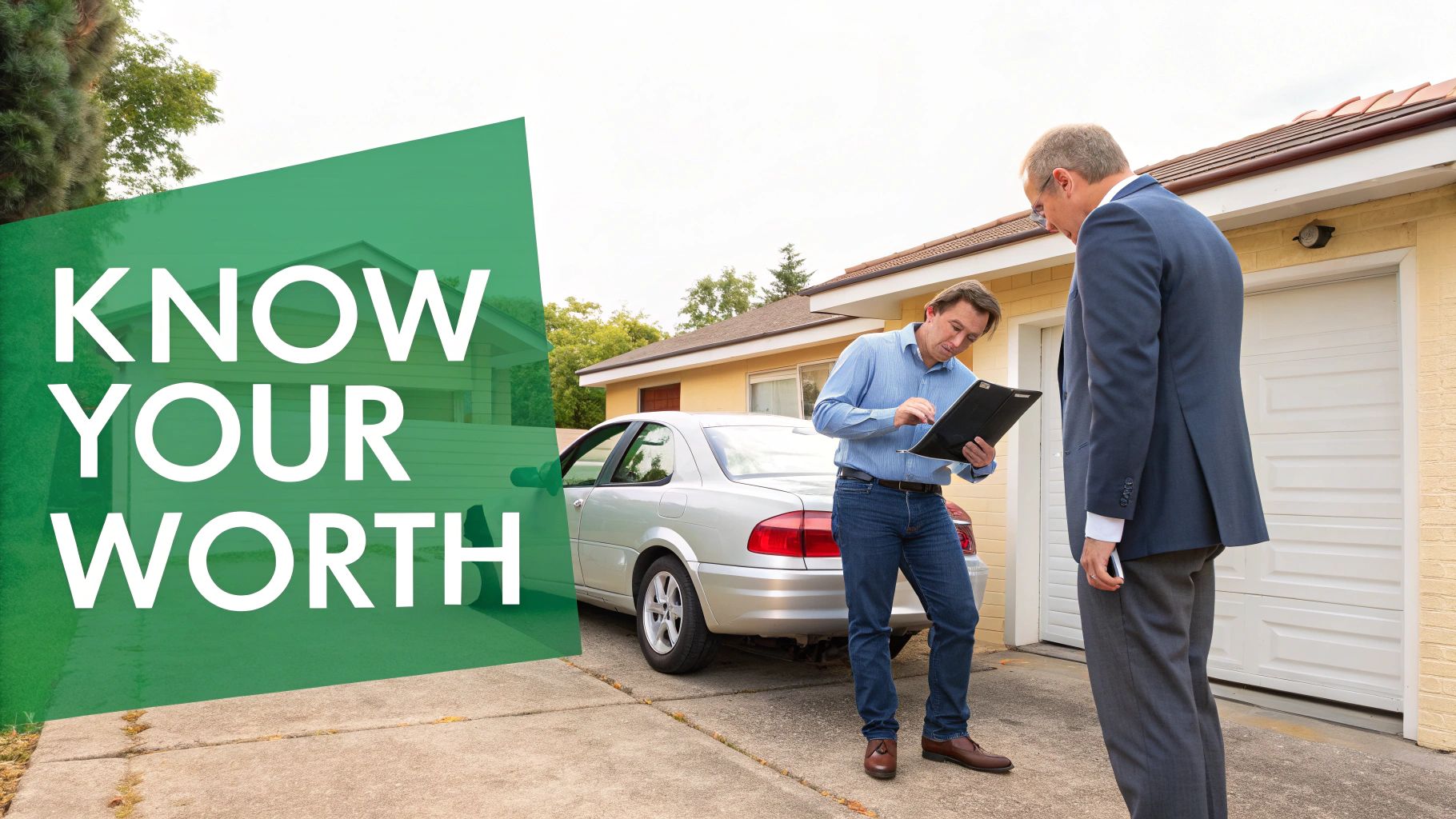
Simply put, a car insurance appraisal is a second opinion from an unbiased expert who’s on your side. After a collision, your insurer conducts its own valuation to determine how much it owes you. But their goal is often to minimize their payout, which is where an independent appraisal becomes essential.
An appraiser works for you, not the insurance company. Their only job is to create a detailed, data-driven report that proves your vehicle’s accurate pre-accident value or its loss in value after repairs. This report provides the hard evidence you need to counter a lowball offer.
The Purpose of an Independent Appraisal
The point of a car insurance appraisal is to level the playing field. Insurers handle thousands of claims daily and have fine-tuned their processes to control costs. A certified appraisal introduces real, verifiable market data into the negotiation, shifting the conversation from opinion to fact.
Specifically, a professional appraisal helps you:
- Prove Diminished Value: It calculates the exact dollar amount your car has lost in resale value just because it now has an accident history.
- Challenge a Total Loss Payout: It establishes the true Actual Cash Value (ACV)—what your car was worth right before the crash—often showing the insurer’s offer is too low.
- Strengthen Your Claim: It provides the credible, third-party documentation you need to demand a fair payout.
Insurer’s Adjuster vs. Independent Appraiser
It’s important to understand the fundamental differences between the valuation you get from the insurance company and one from a certified, independent appraiser. One works to protect the company’s bottom line, while the other works to protect yours.
| Factor | Insurance Company’s Adjuster | Independent Appraiser |
|---|---|---|
| Allegiance | Works for the insurance company. | Works for you, the vehicle owner. |
| Goal | Minimize the insurance payout to control costs. | Determine the vehicle’s true fair market value. |
| Methods | Often uses proprietary software with built-in biases. | Uses court-accepted methods and real-world market data. |
| Objectivity | Inherently biased toward the insurer’s financial interests. | Unbiased, third-party expert focused on accuracy. |
| Outcome | Often results in a lower valuation for your vehicle. | Provides a credible, higher valuation to support your claim. |
The takeaway is clear: an independent appraiser provides the objective, market-based evidence needed to secure a fair settlement.
Understanding Diminished Value vs. Total Loss Appraisals
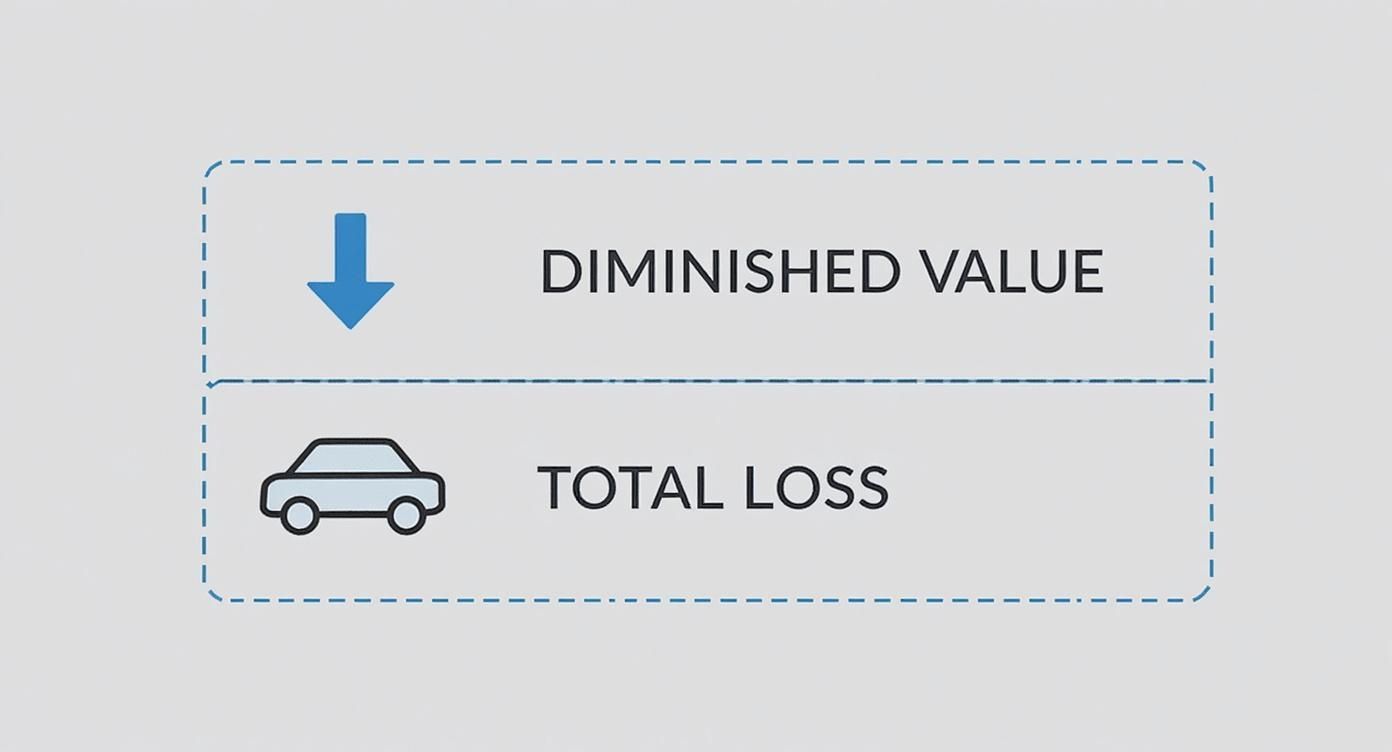
A car insurance appraisal isn’t a one-size-fits-all tool. Its purpose changes depending on whether your vehicle was repaired or declared a total loss. Understanding the difference is the first step toward recovering the money you’re rightfully owed.
Think of these as two different specialists. One calculates the hidden financial damage to a repaired car, while the other proves the true value of a car that’s been written off. Both exist to help you get full compensation for your financial loss.
What Is a Diminished Value Claim?
Imagine two identical used cars on a lot. One has a clean history, while the other was in an accident but repaired perfectly. Which one would you pay more for? That difference in price is its diminished value.
A diminished value claim is your right to be compensated for the loss in resale value your car suffers simply because it now has an accident history. Even with flawless repairs, the market sees your car as less valuable, and that’s a real financial loss.
Insurance companies rarely volunteer to pay for diminished value. A certified appraisal from SnapClaim provides the specific, market-based numbers needed to prove how much your car’s value has dropped so you can demand fair compensation.
Fighting a Low Total Loss Payout
When an insurer declares your car a “total loss,” they are supposed to pay you its Actual Cash Value (ACV). This is the amount a reasonable person would have paid for it right before the crash. However, their first offer is often just a starting point designed to save them money.
Insurers use valuation reports that often undervalue your vehicle by using poor “comparable” cars or applying unfair condition adjustments. Your best defense is a professional, independent total loss payout appraisal.
An independent report from SnapClaim establishes your car’s true pre-accident market value with verifiable data. It gives you the leverage you need to negotiate a much better settlement, turning the conversation from their opinion versus yours into a negotiation based on hard facts.
How an Appraisal Counters Common Insurer Tactics
Insurance companies are experts at minimizing what they pay on claims. Knowing their playbook is the first step in defending yourself against a lowball offer.
The good news? An independent car insurance appraisal is the perfect tool to fight back. It replaces their biased opinions with hard data, giving you the leverage you need to get a fair settlement.
Tactic 1: Using Inaccurate Comparable Vehicles
One of the oldest tricks is undervaluing your car by using bad “comps.” An insurer might justify a low offer by citing vehicles that are a lower trim level, have far more miles, or are for sale in a cheaper market hundreds of miles away.
A SnapClaim report shuts this down. We find true, apples-to-apples comparables by analyzing recent sales of cars that are a match for yours in trim, condition, options, and, most importantly, your local market. This paints a clear picture of your car’s real pre-accident value.
Tactic 2: Applying Unfair Condition Adjustments
Another common tactic is applying excessive “condition adjustments.” The adjuster might unfairly downgrade your car for minor, pre-existing wear and tear—like a small door ding or slightly worn tires—to shave hundreds or thousands off the insurance total loss payout.
Your independent appraisal provides a fair, balanced assessment based on industry standards, not nitpicking. It documents your vehicle’s actual condition, ensuring any adjustments are reasonable. If the insurer still won’t budge, you have the right to be invoking the appraisal clause in your policy, a powerful tool that forces a more formal review.
An appraisal doesn’t just present an opinion; it presents proof. By documenting every upgrade, every feature, and the true market demand for your vehicle, it systematically dismantles the insurer’s lowball tactics.
Tactic 3: Ignoring Your Vehicle’s Upgrades
Did you add a premium sound system, new wheels, or a tow package? Insurers often “forget” to include the value of these upgrades in their initial offer. They prefer to base their numbers on the base model, which can be thousands less than what your customized vehicle was actually worth. This is a common cost-control practice across the global insurance industry.
A certified appraiser, on the other hand, catalogues every single feature and aftermarket addition, assigning a specific market value to each one. This ensures your car value after accident reflects the complete vehicle you owned, not the stripped-down version the insurer wants to pay for.
Turning Your Appraisal Report Into a Better Payout

An independent appraisal report is far more than just a second opinion—it’s your most powerful piece of evidence. Once that certified report is in your hands, you’re no longer just asking for more money. You’re presenting a data-backed case the insurer simply can’t ignore.
This document completely changes the negotiation. Instead of your word against theirs, the conversation now revolves around verifiable market data. A credible car insurance appraisal gives you the precise language and proof needed to argue your case with confidence.
Leveraging the Report for Maximum Impact
Think of your appraisal report as your negotiation toolkit. When you submit it to the adjuster, you are officially challenging their valuation with evidence from a certified expert.
This simple action often gets your claim moved up to a senior adjuster—someone with the authority to approve a higher payout. The goal is to make it easier for them to approve your fair claim than to fight it. To get comfortable with the details, you can learn more by reading our guide on how to read an appraisal report.
Why Data Wins Negotiations
Insurance adjusters are used to unsupported demands for more money. A certified appraisal report immediately stands out because it contains:
- Verifiable Comparables: Real-world examples of similar cars sold in your local market.
- Specific Adjustments: Clear, easy-to-follow math showing how mileage, condition, and options impact the final value.
- Certified Methodology: A formal statement confirming the report was prepared using industry-standard, court-accepted practices.
This level of detail makes your argument professional and incredibly difficult to dismiss. It provides the proof you need to negotiate fairly and supports your case with certified data.
Frequently Asked Questions About Car Insurance Appraisals
Can I get my own appraisal if I disagree with my insurer?
Yes, absolutely. You always have the right to hire your own independent appraiser to determine your vehicle’s true value. The insurer’s offer is just a starting point, and a professional car insurance appraisal provides the evidence you need to negotiate a fair settlement.
Can I claim diminished value if the accident wasn’t my fault?
In most states, yes. If another driver was at fault, you can file a diminished value claim against their insurance policy to recover the loss in your vehicle’s resale value. SnapClaim provides state-specific guides to help you understand your rights.
How much does a professional car appraisal cost?
The cost of an appraisal should be seen as an investment in your claim. A credible report can help you recover hundreds, or even thousands, more than the insurance company’s initial offer. SnapClaim makes this a risk-free decision with our Money-Back Guarantee.
With our guarantee, if your insurance recovery from the claim is less than $1,000, SnapClaim refunds the full appraisal fee — guaranteed.
What if the insurance company ignores my appraisal?
A certified report from a reputable service like SnapClaim is built on court-accepted methods and is very difficult to ignore. If an adjuster initially pushes back, your next step is often to invoke the “appraisal clause” in your policy, which forces a more formal review. Submitting a certified report signals you are serious and have proof, which usually brings them to the negotiating table.
About SnapClaim
SnapClaim is a premier provider of expert diminished value and total loss appraisals. Our mission is to equip vehicle owners with clear, data-driven evidence to recover the full financial loss after an accident. Using advanced market analysis and industry expertise, we deliver accurate, defensible reports that help you negotiate confidently with insurance companies.
With a strong commitment to transparency and customer success, SnapClaim streamlines the claim process so you receive the compensation you rightfully deserve. Thousands of reports have been delivered to vehicle owners and law firms nationwide, with an average of $6,000+ in additional recovery per claim.
Why Trust This Guide
This guide was reviewed and verified by SnapClaim’s auto appraisers, who specialize in diminished value and total loss disputes. Our team continually updates every article to reflect current insurer guidelines, valuation standards, and court-accepted appraisal practices, ensuring that you’re relying on information trusted by professionals nationwide.
Get Started Today
Whether you’re challenging a low total loss settlement or proving your vehicle’s post-repair loss in value, SnapClaim makes it simple to take the next step. Generate a free diminished value or total loss estimate in minutes and see how much compensation you may be owed.
Get your free estimate today or order an independent appraisal report!