
When your insurance company declares your car a “total loss,” their settlement offer is just that—an offer. It’s their opening move, not the final word on what your vehicle was worth. A total loss car appraisal is your expert countermove, providing an independent valuation from a certified professional to establish your vehicle’s true, pre-accident value.
This report is the single most powerful tool you have to negotiate a fair payout and ensure you get the money you deserve.
Understanding The Value Of An Independent Appraisal
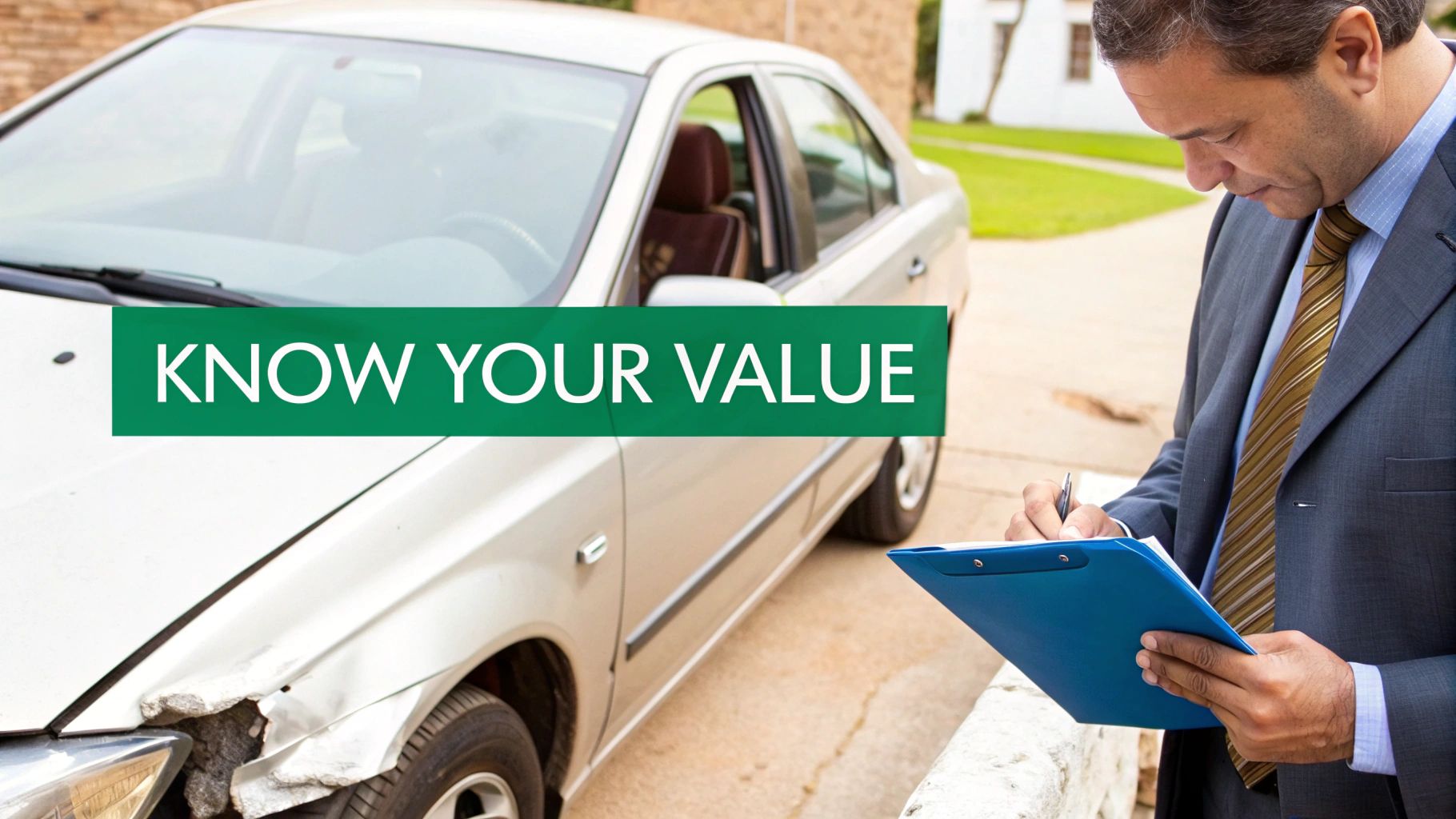
Hearing the words “total loss” after an accident can be jarring. It doesn’t mean your car was flattened; it’s an economic decision. The insurer has simply decided that fixing your car costs more than a certain percentage of its value right before the crash.
This calculation, often called the Actual Cash Value (ACV), is where the dispute usually starts. Insurance companies use valuation models that serve their bottom line, not yours. They often rely on automated systems and generic market data that completely miss what made your car unique.
Why an Independent Total Loss Car Appraisal Is Your Ace in the Hole
Think of it like this: the insurer’s valuation is their opinion, backed by their own data. A total loss car appraisal from a certified, independent expert like SnapClaim is your evidence, backed by professional standards and real, local market analysis.
This simple shift turns the negotiation from an argument into a fact-based discussion where you hold the stronger hand.
An independent appraisal delivers:
- An Unbiased Assessment: It’s an objective look at your car’s actual condition, mileage, options, and upgrades right before the accident, free from the insurer’s cost-cutting agenda.
- Serious Negotiating Power: Armed with a detailed, professional report, you have the proof you need to challenge lowball offers and demand the full insurance total loss payout you’re owed.
- A Clear Path To Getting Paid: It provides the documented evidence required to support your claim if you need to invoke your policy’s appraisal clause to settle the dispute.
Your insurance policy is a contract. When you show up with a data-backed, certified appraisal, you’re simply holding them accountable to their end of the deal—to make you financially whole again.
The Real Story Behind A “Total Loss”
It’s crucial to remember that a “total loss” is just business for the insurer. To get a better handle on the specific rules and thresholds they use, you can learn more about what a total loss vehicle designation really means in our detailed guide. Knowing this helps you understand why their initial number is rarely the final authority on what your car was worth.
To see just how different the two approaches can be, let’s compare them side-by-side.
Insurer Valuation vs Independent Appraisal
| Valuation Aspect | Insurer’s Standard Valuation | Independent Total Loss Appraisal |
|---|---|---|
| Primary Goal | Minimize claim payout to control costs. | Determine the true, fair market value. |
| Data Sources | Automated systems (e.g., CCC, Audatex), generic market data. | Local comparable vehicles, dealer quotes, auction results. |
| Condition Assessment | Often assumes “average” or “fair” condition, deductions applied. | Detailed review of pre-accident condition, including upgrades. |
| Adjustments | Limited or automated adjustments for mileage and options. | Manual, specific adjustments for low mileage, rare features. |
| Objectivity | Inherently biased toward the insurer’s financial interests. | Fully independent, unbiased, and compliant with professional standards. |
| Negotiating Power | Puts the vehicle owner on the defensive. | Empowers the owner with credible, third-party evidence. |
The takeaway is clear: one process is designed to save the insurance company money, while the other is designed to find the truth.
Ultimately, a total loss car appraisal lets you walk into the negotiation with confidence. Instead of just taking what the adjuster offers, you arrive with concrete proof of your car value after accident. It completely levels the playing field and ensures you get every dollar you’re rightfully owed.
How Insurers Calculate Your Car’s Value

When the insurance adjuster declares your car a total loss, they kick off a process to figure out its Actual Cash Value (ACV). This is the number they believe your car was worth just moments before the crash, and it’s the foundation of their settlement offer.
But where does this number actually come from? Most major insurers outsource the job to third-party valuation software like CCC ONE or Audatex. These platforms are built for speed, spitting out a value in minutes by using automated algorithms.
The entire process is designed to serve the insurer’s need for consistency and cost control—not to find the true, unique value of your specific vehicle.
The Automated Valuation Process
These software platforms work by pulling data on so-called “comparable” vehicles from their massive databases. They scan for cars of the same year, make, and model that have been recently listed or sold.
From there, the system makes a series of automated adjustments based on a few key factors:
- Mileage: It adds or subtracts a small amount if your car’s mileage is much higher or lower than the comps.
- Options: Major factory options like a sunroof are factored in, but usually at a heavily depreciated value.
- Condition: This is where things get subjective. The software applies a generic rating—often “average”—and then docks value for every pre-existing ding or scratch the adjuster noted.
The result is a formal-looking valuation report that seems official but is often built on a shaky foundation of flawed data and biased assumptions. This is exactly where a total loss car appraisal becomes your best defense.
Common Flaws In The Insurer’s Report
The convenience of these automated systems comes at the cost of accuracy. The valuation report you get is almost never the final word because it’s often riddled with common errors.
The insurer’s valuation is their opening offer in a negotiation. It is calculated using a system designed for their efficiency, which often means it fails to capture your vehicle’s full worth.
Here are the most frequent problems we see in insurer-provided valuation reports:
- Poorly Chosen Comparables: The “comps” they use might be from a different state where cars sell for less. They could even be base models when you owned a fully-loaded higher trim level.
- Unfair Condition Adjustments: Adjusters often apply harsh deductions for minor, cosmetic wear that had little impact on the car’s real market value.
- Ignoring Upgrades and Maintenance: Did you recently invest in new premium tires or complete a major service? Automated systems almost always miss those valuable details.
- Incorrect Vehicle Options: It’s common for the report to omit factory-installed packages and options, which can significantly undervalue your vehicle right from the start.
By carefully reviewing the insurer’s report, you can pinpoint these inaccuracies. Our guide on the true value of a totalled car dives deeper into how to dissect these reports and prepare your dispute. Remember, the insurer’s number isn’t the end of the story—it’s just the beginning.
Why Are So Many Cars Being Totaled These Days?
If you feel like you’re hearing the word “totaled” more than ever, you’re not wrong. A surprising number of cars are being declared a total loss, and it’s not because people are getting into bigger wrecks. The real story is about modern technology and simple economics.
Today’s cars are loaded with tech—sensors, cameras, and advanced driver-assistance systems (ADAS) are now standard. While these features make roads safer, they also make repairs shockingly expensive. What used to be a simple fender-bender might now mean replacing and recalibrating a dozen sensors, turning a minor repair into a multi-thousand-dollar job.
This new reality has changed the math for insurance companies. When the cost to fix your car gets close to its pre-accident value, it’s often cheaper for them to just write you a check.
The Skyrocketing Cost of Repairs
The biggest factor here is the high cost of auto parts and labor. The sophisticated tech in newer vehicles demands specialized tools and highly skilled technicians, which sends labor rates soaring. On top of that, ongoing supply chain issues have made it harder and more expensive to get the right parts.
This is why cars with what looks like moderate, fixable damage are getting written off. Industry data backs this up; you can read more about the market forces reshaping the auto insurance industry. The economic math—not the severity of the crash—is often what decides your car’s fate.
Why an Accurate Valuation Is Your Only Defense
In this new environment, the insurer’s valuation of your car’s pre-accident worth is everything. If they lowball that number, your car is far more likely to be declared a total loss.
A low Actual Cash Value (ACV) makes any repair estimate look huge by comparison, pushing the claim over the total loss line. This is exactly why you can’t just accept their first offer. Getting a professional total loss car appraisal is your most powerful move.
An accurate, independent appraisal doesn’t just help you get a fair payout; it can be the one thing that saves your car from being totaled in the first place.
Here’s what this all boils down to for you:
- Your Car is More Vulnerable: Even minor bumps can now lead to a total loss declaration because repair costs are so high.
- The Insurer’s Math is Key: A low initial ACV makes it mathematically simple for them to total your car.
- Proof is Your Best Friend: An independent appraisal gives you the hard evidence needed to show what your vehicle was really worth, forcing the total loss calculation to be based on an honest number.
Understanding these forces makes it clear why an independent total loss car appraisal is your tool to make sure the decision is based on fair market facts, not the insurer’s bottom line.
A Step-By-Step Guide to Disputing a Low Offer
That settlement offer from the insurance company? It’s not the final word. You have the right to question it, challenge it, and negotiate for what your vehicle was actually worth.
With the right approach and solid proof, you can successfully dispute their valuation and get a fair insurance total loss payout. This guide will walk you through exactly how to build your case and fight back.
Step 1: Analyze the Insurer’s Valuation Report
The moment that valuation report lands in your inbox, your work begins. Don’t just glance at the final number—dig into the details. This report, often from software like CCC ONE, is frequently filled with errors.
Be on the lookout for these classic red flags:
- Wrong Trim or Options: Did they list your fully-loaded model as a base trim? Did they forget your sunroof or premium sound system?
- Unfair Condition Adjustments: Look for deductions for “average wear and tear” that barely affected your car value after the accident.
- Bad “Comps”: Are the comparable vehicles they used from a cheaper market miles away? Do they have far more mileage?
Every mistake you uncover is ammunition for your negotiation.
Step 2: Gather Your Supporting Documents
Your opinion alone won’t move the needle with an adjuster. You need proof. Before you pick up the phone, build a file of evidence that shows your car’s true condition and value.
Your must-have documents include:
- Recent Maintenance Records: Prove your car was well-cared-for with oil change receipts, tire rotation records, and invoices for major services.
- Receipts for Upgrades: Did you buy new tires or install a new stereo? Receipts prove you invested in the vehicle, increasing its value.
- Pre-Accident Photos: If you have photos showing your car looking clean before the crash, they’re gold. Use them to challenge unfair “condition” deductions.
This paperwork transforms your complaint from “I think it’s worth more” to a fact-based claim.
Step 3: Formally Dispute the Offer in Writing
Once your evidence is in order, it’s time to officially reject their offer. A phone call is fine to start, but you must follow up in writing. An email creates a paper trail and shows you’re serious.
Keep it simple and professional. Clearly state that you are rejecting their settlement offer because it fails to reflect your vehicle’s fair market value. Briefly point out the main errors you found and let them know you have evidence to support a higher valuation.
Step 4: Order a Certified Total Loss Car Appraisal
This is your ace in the hole. An independent total loss car appraisal from a certified expert like SnapClaim completely changes the game. Unlike the insurer’s automated report, our appraisal is a detailed analysis based on real-time, local market data and your car’s specific features.
When you submit a certified appraisal, the power dynamic shifts. It’s no longer your opinion against their software; it’s their flawed report against a professional, data-driven valuation.
Many auto insurance policies include an “Appraisal Clause.” This is a built-in process for settling valuation disputes. By invoking this clause and presenting your independent appraisal, you can often force the insurer to take your dispute seriously.
This step helps ensure the final settlement is based on reality, not a lowball algorithm.
How a Certified Appraisal Strengthens Your Claim
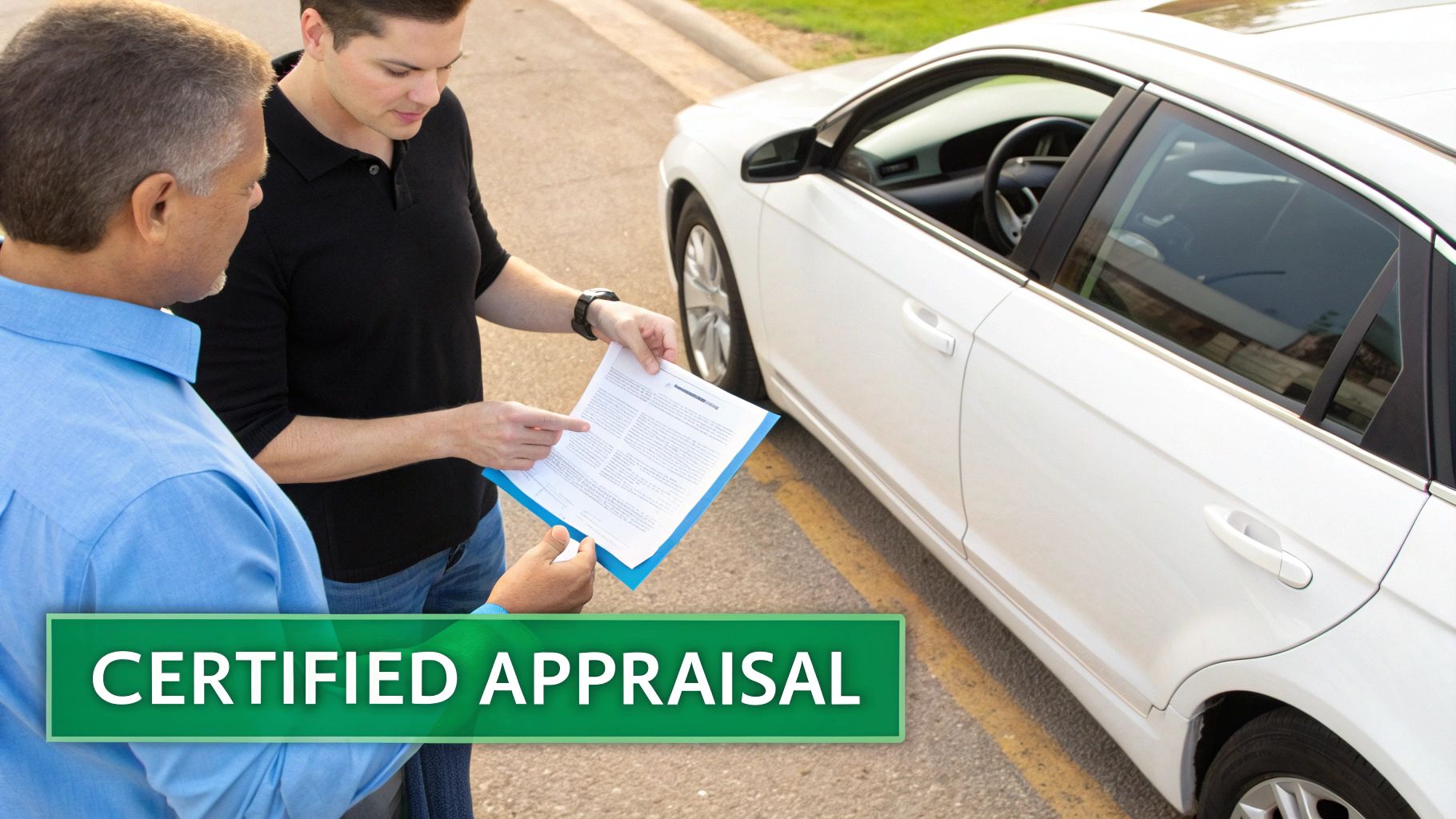
Handing your insurance company a certified appraisal isn’t just asking for a second opinion. It’s like walking into a negotiation with an expert witness on your side. An insurer’s valuation comes from automated software, but a professional appraisal is a deep-dive investigation into what your specific vehicle was truly worth.
This changes the conversation. It’s no longer your word against their algorithm. Suddenly, you have credible, third-party proof that an adjuster can’t easily ignore. It provides the proof you need to negotiate fairly and demand what you’re rightfully owed.
The Power of Professional Standards
What makes a certified appraisal so powerful? It all comes down to the methodology. A professional appraiser performs a detailed market analysis using real, comparable vehicles sold in your local area, ensuring the value reflects what your car was actually worth where you live. This process follows recognized professional standards, making the report credible and defensible.
A certified report from SnapClaim delivers:
- Detailed Adjustments: Fair value is added for your car’s great condition, low mileage, and desirable options—details automated systems often miss.
- Localized Market Data: Valuations are built on real-time sales data from your specific region, not a national average that can lower your car’s value.
- Unbiased Expertise: The appraiser works for you. Their analysis is objective and free from the insurance company’s conflict of interest.
This meticulous approach produces a report that is both accurate and defensible, giving you the solid proof needed to negotiate a fair insurance total loss payout.
A Risk-Free Path to a Fairer Outcome
Committing to a professional appraisal can feel like a big step, but it’s a smart move to protect your finances. The gap between an insurer’s first offer and a fair settlement can be thousands of dollars.
At SnapClaim, we make the decision completely risk-free. If your insurance recovery from the claim is less than $1,000, SnapClaim refunds the full appraisal fee — guaranteed. It’s our way of ensuring you aren’t left out of pocket for fighting for what’s fair.
Getting to the Finish Line: Final Settlement Negotiation
Once you’ve submitted your certified total loss car appraisal, the ball is back in the insurance company’s court. You’ve armed yourself with a professional, data-driven valuation, forcing the adjuster to respond to your evidence.
In the best-case scenario, the insurer accepts your appraisal and agrees to pay the settlement amount. This happens more often than you’d think—your report gives the adjuster the clear evidence they need to justify a higher payout.
Dealing with the Inevitable Counteroffer
More often, the adjuster will come back with a counteroffer. It’ll be higher than their first number but still shy of your appraisal value. Don’t get discouraged! This is a good sign, as it means they know their initial offer was too low.
Now’s the time to stay professional and stick to the facts. Knowing some effective strategies for negotiating with insurance companies can make a huge difference. Politely refer the adjuster back to the specific comparable vehicles and market data in your appraisal. Remind them that your number is based on real-world evidence.
When You’re at a Standstill: Invoking the Appraisal Clause
What if the insurance company just won’t budge? If you’ve reached a stalemate, it’s time to use the “appraisal clause” in your policy. This is a contractual right you have to resolve a dispute.
Here’s how it works: you hire your appraiser, the insurance company hires theirs, and those two appraisers agree on a neutral third-party “umpire.” A final, binding decision is reached when any two of the three agree on a value. It’s a formal process that ensures the final number is based on expert analysis.
This is especially important for older vehicles. Data shows 32% of vehicles seven years or older are being written off as total losses. You can discover more about these total loss trends to see just how critical a fair and accurate valuation has become.
Frequently Asked Questions About Total Loss Car Appraisals
Can I keep my car if it’s declared a total loss?
Yes, in most cases you can. This is called “owner retention.” The insurance company will pay you the car’s Actual Cash Value (ACV) minus its salvage value (what it’s worth for parts). However, your vehicle will be given a “salvage title,” which can make it difficult to insure or sell later. You’ll also need to have it repaired and pass a state inspection before it can be legally driven again.
What if the at-fault driver’s insurance is delaying my total loss claim?
If the other driver was at fault, their insurance company is responsible for paying your claim. However, delays are common. To speed things up, you can file the claim under your own collision coverage (if you have it). Your insurance company will pay you and then go after the at-fault driver’s insurer for reimbursement, a process called subrogation. This is often the fastest way to get your settlement.
How is a total loss different from a diminished value claim?
A total loss means your car is not being repaired, and the insurance company pays you for its pre-accident value. A diminished value claim applies when your car is repaired. It compensates you for the loss in resale value your vehicle now has because of its accident history. Even after perfect repairs, a car with an accident record is worth less than one without. You can find more information in our Diminished Value and Total Loss guides.
Can I get a rental car while my total loss claim is being processed?
Coverage for a rental car depends on your policy (or the at-fault party’s policy). Typically, rental coverage ends once the insurance company makes a settlement offer for your totaled vehicle. It’s important to act quickly to resolve your claim so you aren’t left without transportation.
About SnapClaim
SnapClaim is a premier provider of expert diminished value and total loss appraisals. Our mission is to equip vehicle owners with clear, data-driven evidence to recover the full financial loss after an accident. Using advanced market analysis and industry expertise, we deliver accurate, defensible reports that help you negotiate confidently with insurance companies.
With a strong commitment to transparency and customer success, SnapClaim streamlines the claim process so you receive the compensation you rightfully deserve. Thousands of reports have been delivered to vehicle owners and law firms nationwide, with an average of $6,000+ in additional recovery per claim.
Why Trust This Guide
This guide was reviewed and verified by SnapClaim’s auto appraisers, who specialize in diminished value and total loss disputes.
Our team continually updates every article to reflect current insurer guidelines, valuation standards, and court-accepted appraisal practices, ensuring that you’re relying on information trusted by professionals nationwide.
Get Started Today
Whether you’re challenging a low total loss settlement or proving your vehicle’s post-repair loss in value, SnapClaim makes it simple to take the next step.
Generate a free diminished value or total loss estimate in minutes and see how much compensation you may be owed.
👉 Get your free total loss value estimate today